- The Human Guide
- Posts
- What satisfies billionaires but terrifies 55,000 workers who lost their jobs in 2025?
What satisfies billionaires but terrifies 55,000 workers who lost their jobs in 2025?
Plus: The quiet exodus of smart money from AI stocks

Felix Khakame
December 29, 2025
What investment is rudimentary for billionaires but ‘revolutionary’ for 70,571+ investors entering 2026?

Imagine this. You open your phone to an alert. It says, “you spent $236,000,000 more this month than you did last month.”
If you were the top bidder at Sotheby’s fall auctions, it could be reality.
Sounds crazy, right? But when the ultra-wealthy spend staggering amounts on blue-chip art, it’s not just for decoration.
The scarcity of these treasured artworks has helped drive their prices, in exceptional cases, to thin-air heights, without moving in lockstep with other asset classes.
The contemporary and post war segments have even outpaced the S&P 500 overall since 1995.*
Now, over 70,000 people have invested $1.2 billion+ across 500 iconic artworks featuring Banksy, Basquiat, Picasso, and more.
How? You don’t need Medici money to invest in multimillion dollar artworks with Masterworks.
Thousands of members have gotten annualized net returns like 14.6%, 17.6%, and 17.8% from 26 sales to date.
*Based on Masterworks data. Past performance is not indicative of future returns. Important Reg A disclosures: masterworks.com/cd
Hello, Human Guide Reader,
Today, we will talk about these stories:
AI minted 50+ new billionaires while cutting 55,000 jobs
Why legendary investors are betting against the AI boom
A new study says AI might actually make you more creative
AI created 50 new billionaires in a single year

The wealth transfer happened faster than anyone expected.
In 2025, the AI boom didn't just make the rich richer, it created an entirely new class of billionaires almost overnight. According to Forbes, more than 50 people crossed the billion-dollar threshold this year thanks to AI, making it one of the fastest wealth-creation events in modern history.
These weren't the usual suspects. Bret Taylor and Clay Bavor became billionaires by founding Sierra, a startup that replaces human customer service agents with AI bots. Three 22-year-old Thiel fellows, Brendan Foody, Adarsh Hiremath, and Surya Midha, broke Mark Zuckerberg's record as the youngest self-made billionaires after their company Mercor, which converts expert knowledge into AI training data, exploded in value.
Meanwhile, the established tech titans saw their fortunes swell to unprecedented levels. Elon Musk's net worth jumped nearly 50% to $645 billion. Google founders Larry Page and Sergey Brin added roughly $102 billion and $92 billion respectively. Nvidia's Jensen Huang gained $41.8 billion as his company's valuation hit $5 trillion, even after he sold nearly $1 billion in shares.
But here's the uncomfortable truth: while AI minted billionaires, it also eliminated jobs. A report revealed that AI was directly linked to over 55,000 layoffs in the US this year alone. The same technology creating extreme wealth at the top is hollowing out the middle.
The numbers tell a stark story. The top 10 US tech billionaires now control a combined $2.5 trillion, more than the GDP of most countries. Mark Zuckerberg added $81 billion to his fortune. Larry Ellison gained $57.4 billion. Jeff Bezos saw his wealth increase by $50 billion. These gains happened in a single year.
What makes this different from previous tech booms is the speed and concentration. The dot-com era created billionaires over decades. Social media took years to mint its moguls. AI did it in months. And unlike previous waves, the wealth isn't spreading to thousands of early employees and investors, it's concentrating in fewer and fewer hands.
The question nobody wants to ask: if AI is supposed to benefit everyone, why does the money only flow one direction?
The smartest investors are quietly heading for the exits
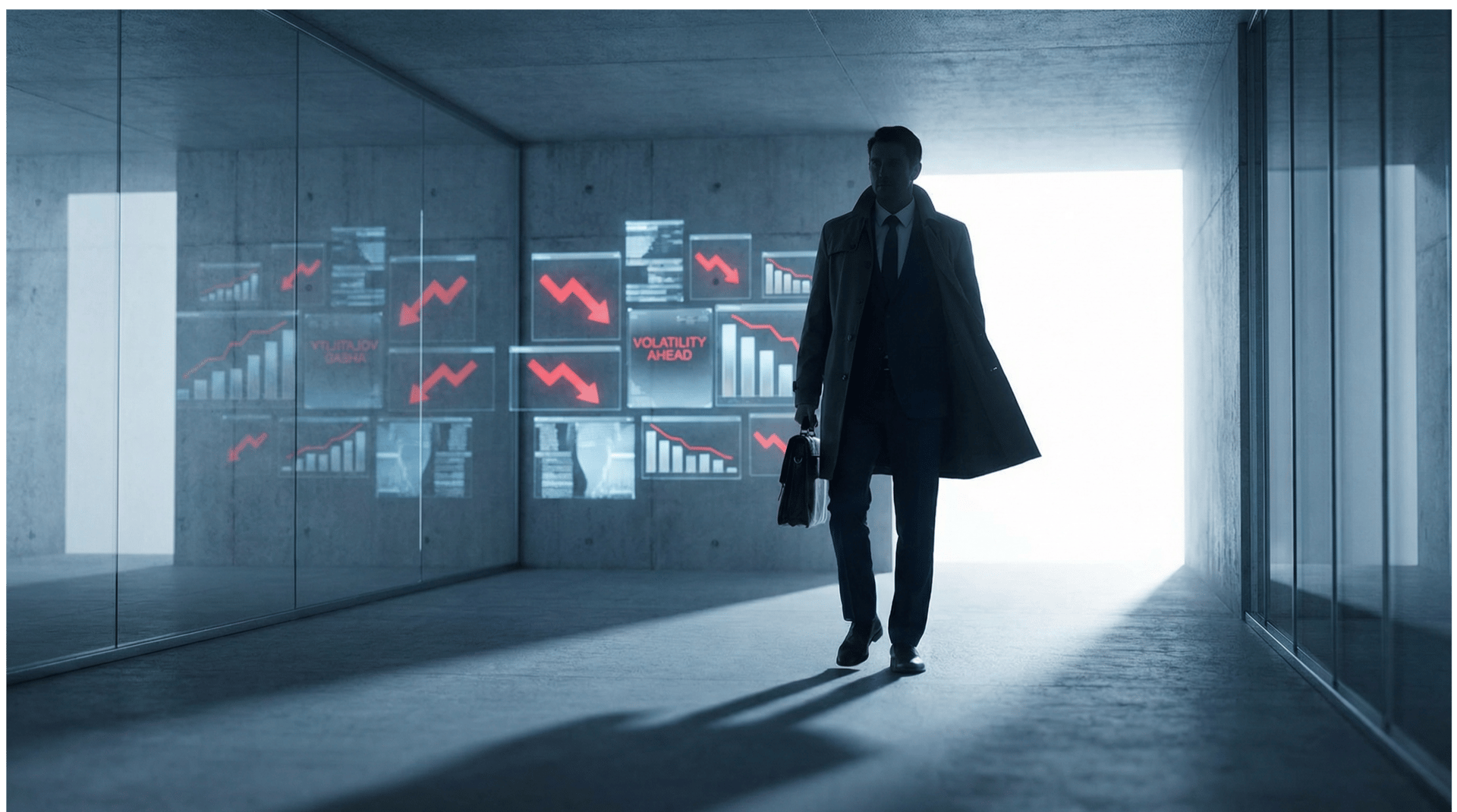
Two of the most famous contrarian investors just made the same bet.
Peter Thiel's Founders Fund sold its entire $100 million stake in Nvidia earlier this year. Around the same time, Michael Burry, the investor who predicted the 2008 housing crash and was immortalized in "The Big Short", placed a nearly $200 million bet against the chipmaker. These aren't random traders panic-selling. These are people who built their reputations on seeing what others miss.
Their concern isn't just about Nvidia. It's about an entire industry built on a single assumption: that bigger models, more data, and more computing power will keep delivering proportional improvements. That assumption is starting to crack.
Models today are orders of magnitude larger than they were just a few years ago, but they're not getting proportionally smarter. GPT-4 has hundreds of billions of parameters. The next generation will have trillions. But the leap in capability isn't matching the leap in scale. The costs in power, chips, and data centers keep climbing while the returns are flattening.
Hallucinations persist. Edge cases still break systems. And the supply of high-quality training data is running dry. Some researchers estimate we've already used most of the internet's useful text for training. What comes next?
The Bank of England has already warned that markets look stretched if AI expectations cool. Meanwhile, 75% of US homes are now rated unaffordable based on average income, and first-time homebuyers made up just 24% of purchases last year, down from 50% in 2010. The AI boom is happening in a very different economy than the one most people experience.
There's also the infrastructure question. AI companies are building data centers that consume as much power as small cities. They're competing for limited chip supplies. They're hiring engineers at salaries that would have seemed absurd five years ago. All of this assumes the growth continues indefinitely.
But what if it doesn't? What if we're approaching the limits of what current architectures can achieve? What if the next breakthrough requires something fundamentally different, something that makes today's massive investments obsolete?
Thiel and Burry aren't saying AI is worthless. They're saying the current valuations assume perfection. And in markets, perfection is rarely priced correctly.
If the smartest money is getting nervous, should everyone else be paying attention?
AI didn't kill creativity. It might actually unlock it. (New Research)

The study found something nobody expected: worse options led to better outcomes.
Researchers at Swansea University ran an experiment with over 800 participants using an AI system to design virtual cars. But instead of optimizing toward one "best" answer like most AI tools do, this system showed users a wide gallery of designs, including awkward, inefficient, and downright ugly ones, using a technique called MAP-Elites.
The results were counterintuitive. By slowing people down and forcing them to consider strange options, the AI actually pulled users deeper into the creative process. Participants stayed engaged longer, explored more possibilities, and ultimately produced stronger final designs than those using traditional optimization-focused tools.
The paper, published in ACM Transactions on Interactive Intelligent Systems, argues that most AI metrics are measuring the wrong things. We optimize for speed and efficiency, but what actually matters for creative work is engagement and exploration. If that's true, many "successful" AI tools might be succeeding at the wrong goals entirely.
Think about how most AI tools work today. You type a prompt, you get an answer. The system is designed to give you the "best" response as quickly as possible. But creativity doesn't work that way. Real creative breakthroughs come from exploring dead ends, considering weird possibilities, and making unexpected connections.
The Swansea research suggests that AI's real power might not be in giving us answers, but in showing us possibilities we'd never consider on our own. Instead of replacing human creativity, AI could expand it, but only if we design systems that prioritize exploration over efficiency.
This matters because the dominant narrative around AI and creativity has been fear, that machines will replace human imagination. But this research suggests something more nuanced. The tools that make us most productive might not make us most creative. And the tools that seem "worse" by conventional metrics might actually be better for the work that matters most.
What if the future of AI isn't about getting faster answers, but about asking better questions?
If showing people bad ideas helps them think better, what else should AI stop hiding from us?